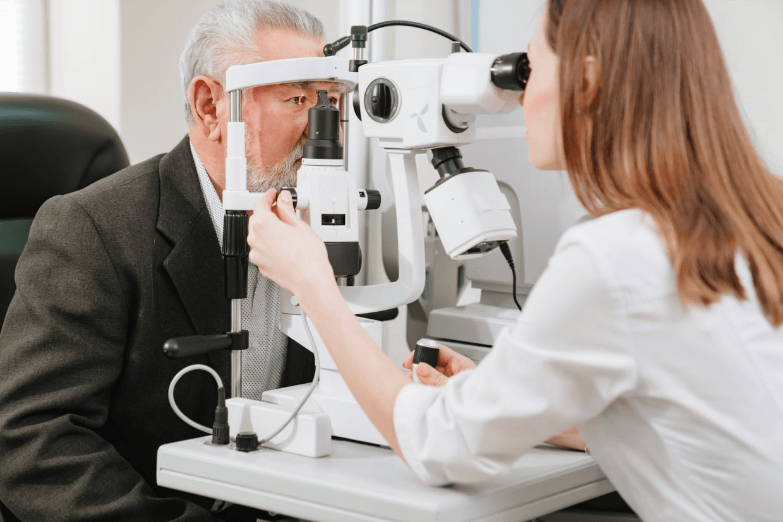
Vision changes can be gradual. Sometimes the first clue is simply that familiar work tasks start taking more effort. Emails need a larger font. A spreadsheet looks slightly hazy. Bright conference-room lights become annoying. Driving home after dark feels less comfortable than it used to.
Dr. James C. Loden, from Loden Vision Centers, notes that people considering cataract surgery in Nashville may first seek an eye exam after everyday tasks such as reading or driving become noticeably harder.
Cataracts develop when the normally clear lens inside the eye becomes cloudy. Over time, they can cause blurry or hazy vision, faded colors, sensitivity to light, and difficulty seeing at night [1]. Those changes can show up almost anywhere, including at work.
That does not mean every frustrating screen or difficult commute is caused by cataracts. Prescription changes and other eye conditions can produce similar problems. What matters is noticing when ordinary visual tasks have become consistently harder.
Blurry text can make simple tasks take longer
Reading is built into many workdays. It might mean answering email, reviewing a contract, checking inventory numbers, studying a report, or switching between several windows on a computer.
When vision becomes cloudy or blurry, those jobs can require more concentration.
A cataract forms in the eye’s natural lens, which normally helps focus light so you can see a clear image. As the lens becomes cloudier, vision can become hazy and less colorful [1].
At first, the change may be easy to work around.
You increase the zoom on a document. You lean toward the monitor. You turn on another light before looking at printed paperwork. Maybe you update your glasses prescription and notice some improvement.
These small adjustments can help during the earlier stages of cataracts. The National Eye Institute specifically notes that brighter lighting, magnification, and a new glasses or contact lens prescription may make everyday activities easier for some people with early cataracts [1].
The important part is noticing whether those fixes continue to work.
If you once read a full page comfortably and now keep losing your place because the words look hazy, the issue is no longer just an inconvenience. The same is true if you need increasingly large text to read information you used to see easily.
The slowdown can be easy to miss. A task that once took five minutes may take ten because you reread lines, adjust the screen, or pause to get a clearer look.
None of that proves you have cataracts. It does give you useful information to bring to an eye exam.
Glare and poor contrast can affect screens and meetings
Blur is not the only visual change that can interrupt a workday.
Cataracts can make lights seem too bright and colors look faded [1]. In a workplace, that may become noticeable under overhead lighting, around bright windows, or when moving between a dark room and a bright screen.
Think about a presentation in a conference room. The lights are dimmed, but the projector still throws a bright image across the wall. Text that used to stand out may seem washed out. Small details in charts become harder to pick apart.
Computer work can create another version of the same problem.
Cataracts can also reduce contrast sensitivity, which may make subtle interface elements or low-contrast graphics harder to distinguish [3].
Increasing brightness does not always solve the problem because brighter light itself may become uncomfortable.
People often make reasonable adjustments before connecting the problem with their eyesight. They change the display contrast, increase text size, close the blinds, or move to another desk.
There is nothing wrong with doing that. Better lighting and more readable screen settings can make work more comfortable for anyone.
But if lighting that used to feel normal now seems harsh, colors look duller, or visual details are becoming harder to separate, mention those changes during an eye exam.
It also helps to notice whether the same issue appears outside work. If glare bothers you in the office and headlights have become more distracting at night, that is a more useful pattern than either symptom considered by itself.
The commute may reveal vision changes first
A person can control plenty of things at a desk. You can enlarge text, reposition a monitor, add a lamp, or move closer to what you need to see.
Driving gives you fewer options.
Cataracts can make it harder to see at night and can increase sensitivity to light [1]. For some people, the drive to or from work becomes one of the first situations where changing vision is difficult to ignore.
Maybe the morning commute feels normal, but the evening trip does not. Headlights seem brighter. Street signs take longer to read. Wet roads or poorly lit intersections demand more concentration.
The change may be gradual enough that you adapt without realizing how much extra effort you are making.
That matters because driving is one of the everyday activities doctors consider when discussing cataract treatment. The National Eye Institute explains that cataract surgery may be suggested when vision loss starts interfering with activities such as reading or driving [2].
A diagnosis alone does not mean surgery must happen immediately.
Many people can manage early cataracts for a period of time with better lighting, updated glasses, or other adjustments. NEI notes that most people do not need to rush into surgery and recommends discussing the benefits and risks with an eye doctor [1].
The decision becomes more practical when cataracts begin limiting things you need or want to do.
For someone who rarely drives at night, mild glare might not create much difficulty. For someone who commutes before sunrise, works evening shifts, or spends hours on the road, the same visual change may matter much more.
Your job does not determine whether you need cataract surgery, but your daily visual demands are part of the conversation.
See also: Comprehensive Canine Health Assessment Guide
When everyday work problems are worth an eye exam
It is easy to blame visual fatigue on a busy week.
Sometimes that is exactly what is happening. But persistent changes deserve more attention than an occasional difficult afternoon.
Consider scheduling an eye exam if you notice patterns such as:
- Text remaining blurry even after you adjust the screen or lighting
- Needing substantially brighter light to read comfortably
- Colors looking duller than they used to
- Increasing sensitivity to bright lights
- More difficulty driving at night
- Frequent changes to your glasses prescription
- Everyday visual tasks taking noticeably more effort
These symptoms do not confirm a cataract. A dilated eye exam is used to check for cataracts and other eye problems that may affect vision [1].
If cataracts are found, the next question is not simply, “Do I have them?”
A more useful question is, “How much are they affecting what I need to do?”
Surgery is the only way to remove a cataract. During the procedure, the cloudy natural lens is removed and replaced with an artificial lens called an intraocular lens, or IOL [2]. But the timing of surgery is usually tied to how much the cataract is interfering with everyday activities and to the person’s overall eye health and goals.
That makes the consultation a good place to talk about real situations rather than giving only a general description such as “My vision seems worse.”
Explain that you struggle with small numbers on a screen. Mention that night driving is becoming difficult. Bring up glare in bright rooms or the fact that printed material takes longer to read.
Those examples help describe the practical impact of the vision change.
Loden Vision Centers provides cataract evaluations and cataract surgery as part of a broader ophthalmology practice serving five locations in Greater Nashville, along with routine eye exams and care for conditions including glaucoma, dry eye, and retinal problems [4]. The practice also offers multiple lens implant options that can be reviewed during a cataract evaluation [4].
Work is only one part of life, but it can make gradual vision changes easier to spot. When reading, screens, meetings, or the commute consistently require more effort, it may be time to find out what has changed rather than continuing to work around it.
Sometimes the problem is as simple as an updated prescription. Sometimes an eye exam finds a cataract or another condition that needs attention.
Either way, knowing the reason is more useful than endlessly turning up the screen brightness.